Tħē ŞîĠńaŁ, Ťħë SǐĞņ, Tħě ŚìĽěŅçê
The broadcast finished, but the silence that followed was louder.
Across Earth the frequency had sunk into the ground, into the wires, into the blood. City lights flickered in perfect rhythm with the residual pulse. Radios that had been dead for years suddenly hissed the same low celestial tone. In the streets people stopped mid-step, phones glowing with the same impossible waveform, staring upward as if the sky itself had just spoken and then refused to explain.
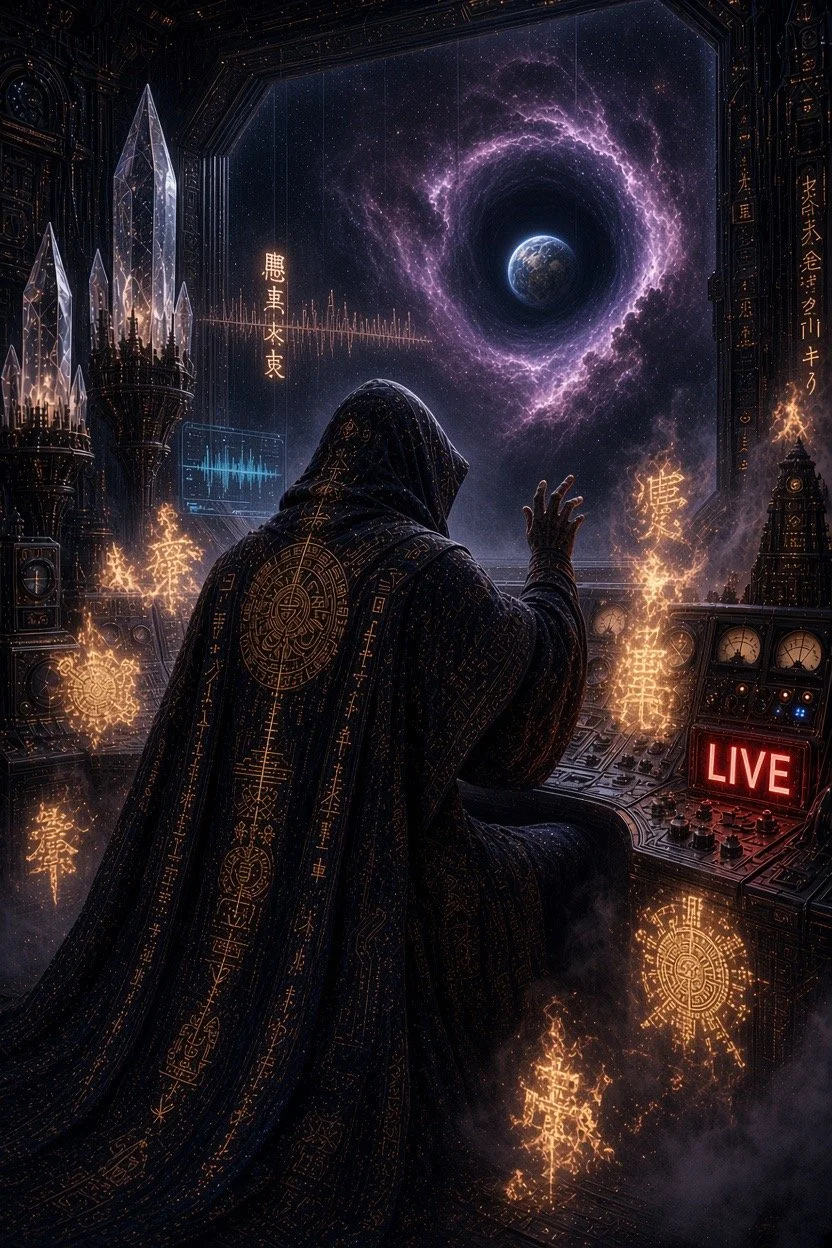
Back in the station the cloaked figure still sat with its back to everything.
The red LIVE light did not go out.
Instead the consoles around it began to answer on their own. Aztec sun-discs spun in golden light. Japanese holographic kanji bloomed and burned away like paper in rain. The nebula outside the viewport twisted tighter, forming a single dark spiral that pointed straight at the planet below.
The alien raised one hand—not in greeting, not in threat—only in dismissal.
A second signal left the station, heavier than the first. This one carried no melody. It was pure refusal made into sound: a final, crushing frequency that told every listening mind the same thing without words.
We saw what you did to the garden.
We will not speak to you.
We are already leaving.
The cloak shifted. The hood never turned. The LIVE light stayed on for three more heartbeats… then cut to black.
Outside the viewport the stars began to move.
The second signal faded into the black.
For a moment the station hung in perfect stillness. Then the entire structure began to move. Not with engines, not with sound—simply by deciding that Earth no longer deserved its presence. The spiral of purple energy outside the viewport tightened around the blue planet like a closing eye, then stretched into a long, luminous corridor of departure.
The cloaked figure finally rose.
Still facing away. Still silent. The heavy robes of gold-threaded Aztec geometry and glowing Japanese circuitry unfolded as it stood, the hood never turning toward the world it had judged. Around its feet the consoles went dark one by one. The last red LIVE light winked out.
A final, almost gentle frequency left the station—so low it was felt more than heard. It carried no anger this time. Only the quiet finality of something ancient walking away from a ruined garden and never looking back.
Outside, the stars rushed past. Earth shrank into a single blue spark and then vanished behind the closing spiral.
The alien was already gone.
The spiral swallowed the station whole.
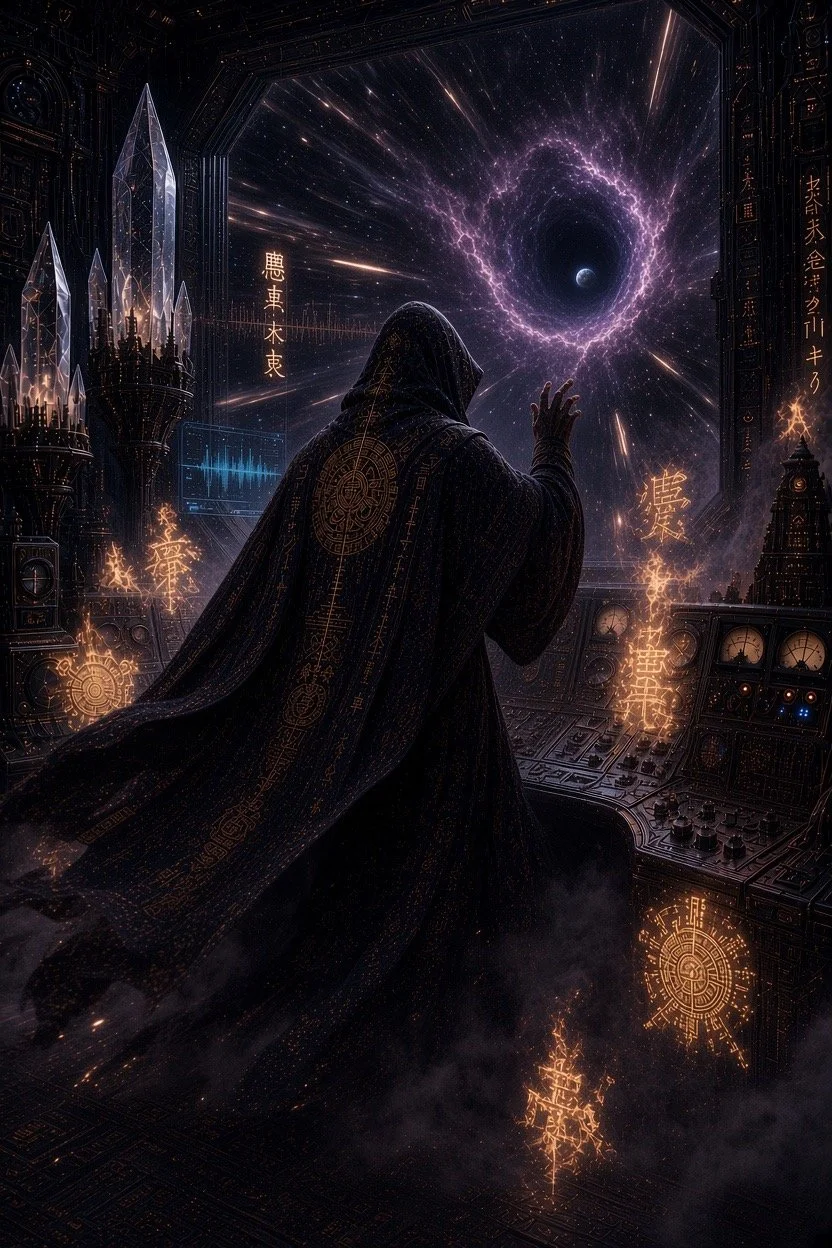
There was no sound of engines, no final transmission, no last glance. The purple corridor of light simply closed behind them like a door that had never been open. Stars became pure white streaks. Space itself stretched and folded. Earth was gone—reduced to a memory the alien had already chosen to forget.
Inside the darkened chamber the cloaked figure remained standing, back still turned to the place it had judged. The golden Aztec sun-discs and Japanese circuit runes along its robes slowly dimmed, as if the very symbols were being unwritten. Mist curled higher. The last residual glows on the dead consoles faded to black.
For a moment the silhouette stood alone against the rushing void.
Then the figure itself began to dissolve—edges of the heavy cloak turning into drifting particles of gold and violet light, the hood losing definition, the entire presence gently coming apart like smoke given permission to leave.
No words.
No farewell.
Only the quiet certainty that something ancient had looked upon the ruined garden, delivered its judgment, and walked away forever.
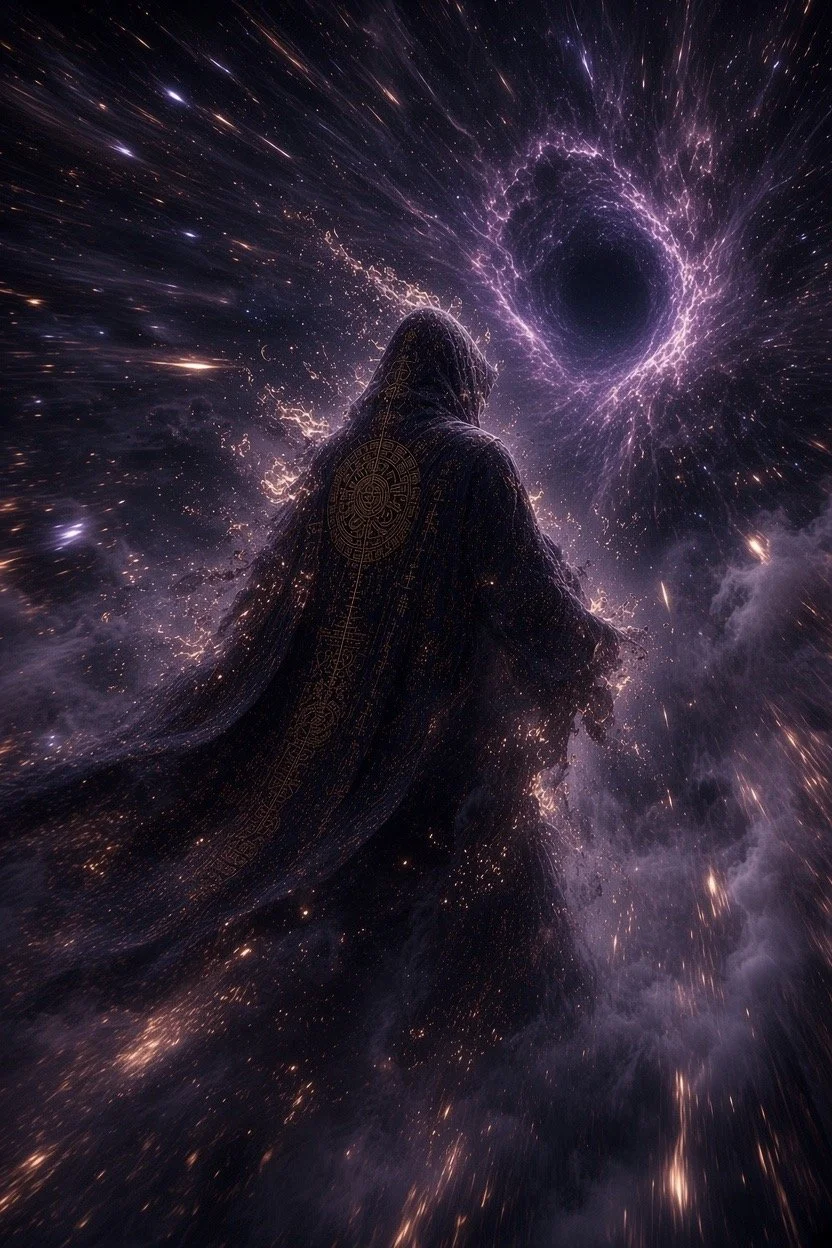
The last particles of gold and violet light scattered into the spiral.
For a single breath the shape of the cloak still lingered—hood, shoulders, the long fall of embroidered cloth—then it too came apart. The ancient symbols unwrote themselves. The presence that had judged a world simply ceased to be.
The purple corridor collapsed inward with the quiet finality of a closing eye. Stars stopped streaking. The violent rush of departure ended.
Where the station had been, where the figure had stood, there was now only the ordinary dark of deep space. No wreckage. No signal. No residual glow.
Just silence.
On Earth the residual frequency faded from every radio, every phone, every nervous system that had felt it. People looked up at an empty sky and understood, without words, that something vast had come, delivered its verdict, and left forever.
The garden remained.
The gardener did not.
The silence that followed was absolute.
On Earth, the last traces of the frequency drained from the air like water leaving a cracked bowl. Radios returned to static. Phones went dark. The night sky, for the first time in hours, held nothing unusual—only the ordinary stars that had watched the entire judgment without comment.
In cities and deserts and quiet rooms, people stood still. Some waited for another signal. Some whispered questions into the dark. Most simply felt the weight of having been seen, measured, and left behind.
No second chance arrived.
No explanation.
No return.
Years later, the only proof that anything had happened at all would be the recordings: a low, impossible frequency that still makes the skin tighten when played, and the shared memory of a single red LIVE light that once burned in the void above them… then went out forever.
The garden remained.
The one who had come to judge it did not.
The frequency did not begin the night the alien arrived.
It was older than the spiral corridor. Older than the station. Older than the disappointment that brought the cloaked figure to Earth.
Long before it touched a single human radio, the frequency lived in a place where light itself had grown tired.
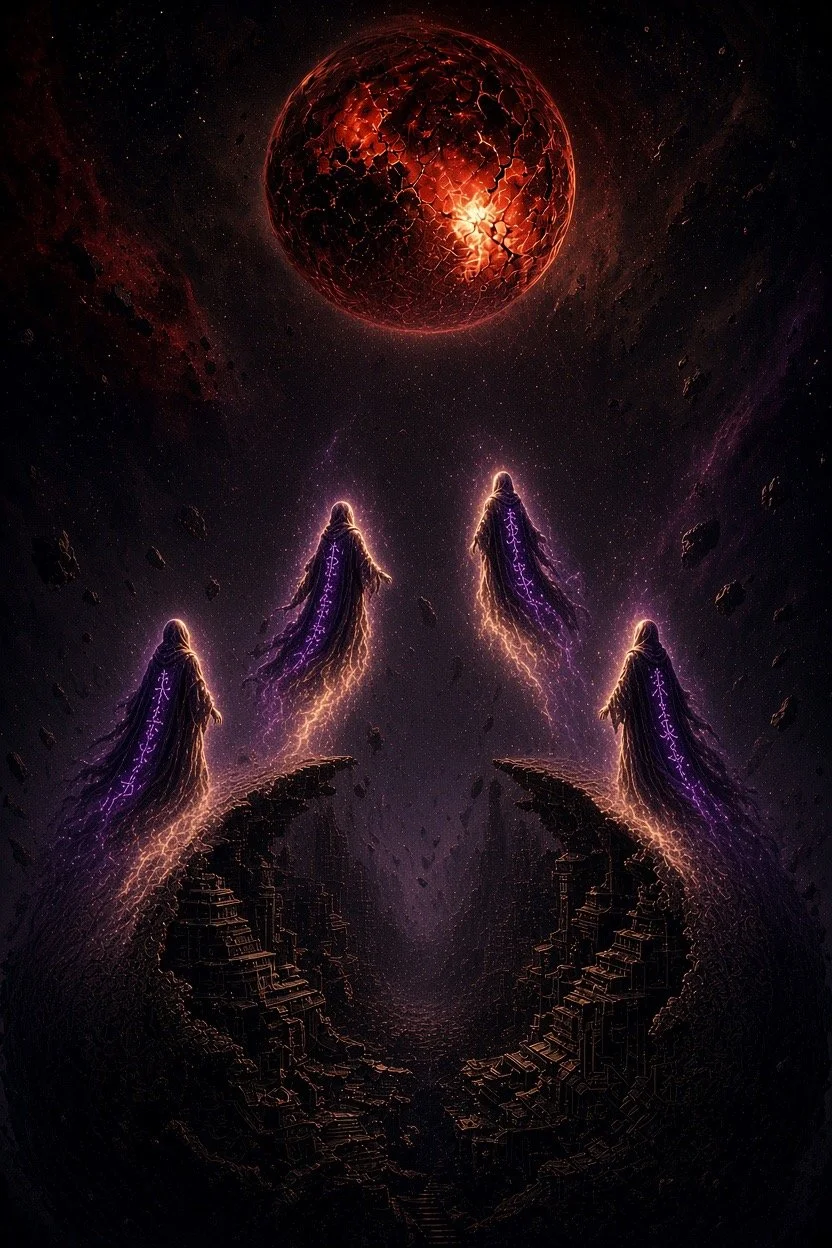
In a forgotten arm of the galaxy, a star had once burned too brightly and then collapsed into a slow, wounded ember. Around that dying star floated the remains of a world that had also been a garden. Its people had done what Earth’s people would later do—taken more than the soil could give, spoken louder than the silence could bear, and finally stood under an empty sky wondering why nothing answered.
When their own judgment came, it did not arrive as a visitor in a cloak.
It arrived as sound.
A single, perfect frequency rose from the core of their ruined planet—born from the friction between what they had been and what they had become. It was not made by any machine. It was the planet itself, speaking its last true word. The sound carried the weight of every forest that no longer stood, every ocean that no longer moved, every promise that had been broken in the name of progress.
The cloaked ones—the ones who travel between gardens—heard it.
They did not invent the frequency.
They only learned how to carry it.
They learned how to hold that final note inside their vessels and their robes, how to keep it pure across centuries of dark, how to release it only when another world had earned the same silence. The frequency was never a weapon. It was a mirror made of sound. A reminder. A closing door.
When the alien raised its hand above Earth and let the drop fall, it was not creating something new.
It was delivering a message that had already been spoken once, by a planet that no longer existed, to a species that had already been left behind.
The origin was never the alien.
The origin was the first garden that failed.
And the frequency still remembers the taste of that failure.
The Frequency was born.
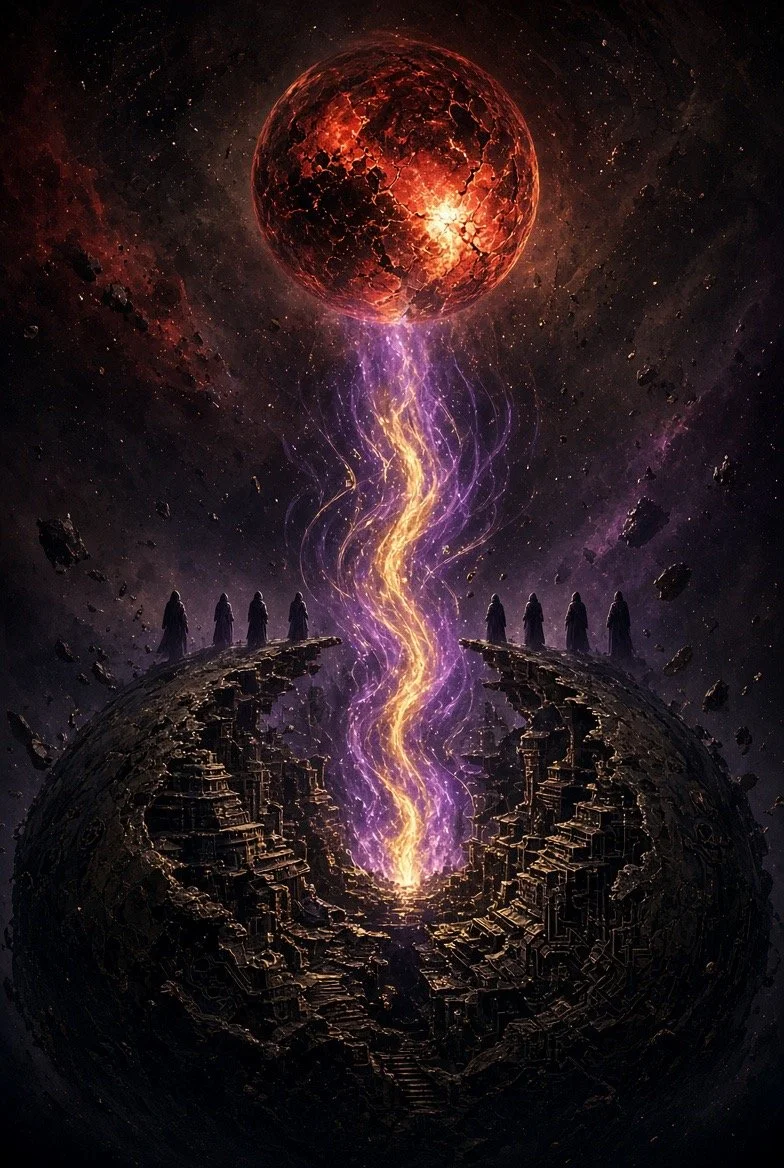
The frequency rose, and the cloaked ones did not look away.
They stood on the fractured rim of the dead world and listened as the planet spoke its final truth. When the column of purple-and-gold sound reached its peak, they stepped forward—not to silence it, but to receive it. One by one they opened their hands, their robes, the hollow spaces inside their forms, and the living frequency poured into them like liquid light.
It did not burn.
It remembered.
Each carrier took a portion of the original note and sealed it within the embroidery of their cloaks, within the geometry of their vessels, within the quiet places where judgment is kept. Then they turned from the dying star and walked into the dark, carrying the sound of a failed garden across the long silence between stars.
Centuries passed.
Worlds were watched.
Some were left alone.
Some received the frequency when the time for mirrors finally arrived.
One of those carriers eventually reached Earth.
The drop that fell from the orbital station was never a new invention. It was the same ancient note—still pure, still heavy with the memory of the first world that broke itself—delivered by a figure who had been present at its birth.
The origin was never lost.
It only traveled.
In a moment, the frequency was taken
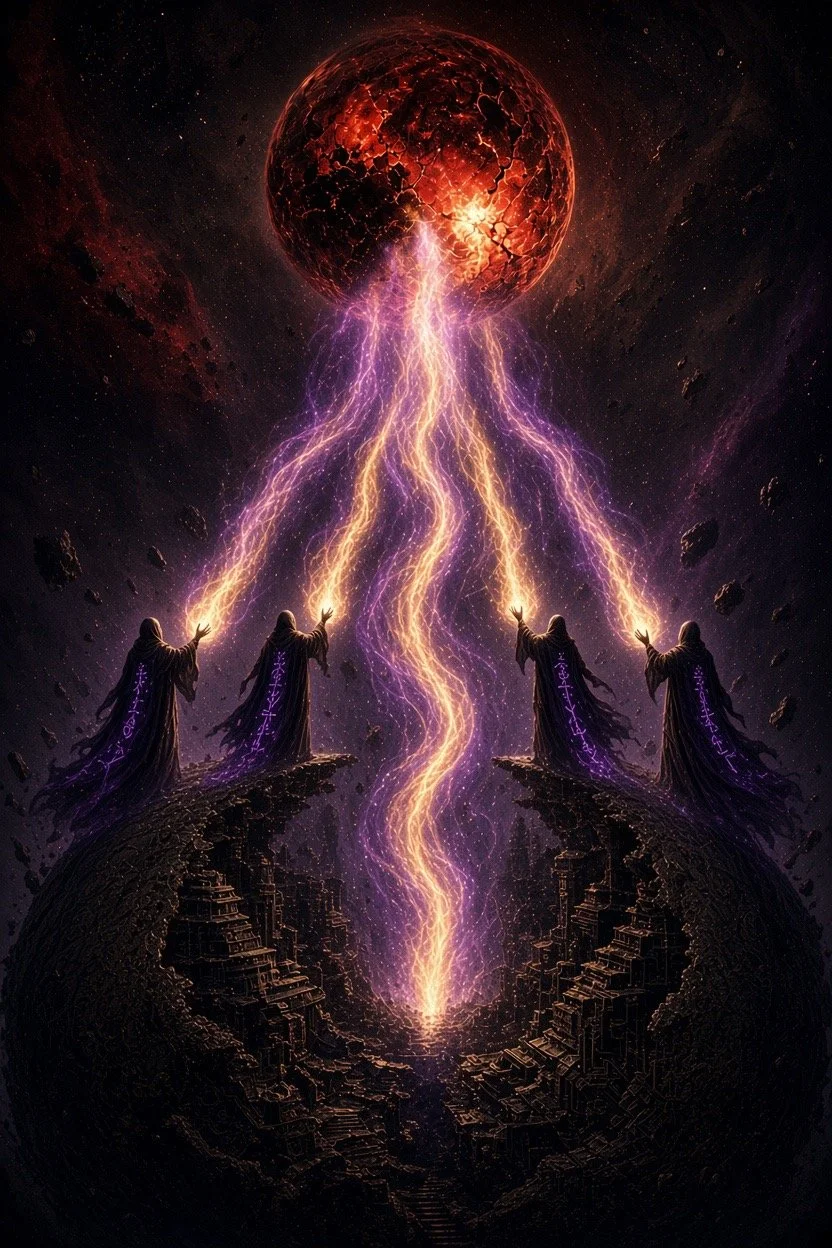
The frequency settled into them.
One by one the streams of purple-and-gold light thinned and vanished. The column that had risen from the dead world’s core sank back into the cracked earth, spent. The dying star continued its slow collapse overhead, indifferent.
The cloaked figures lowered their hands. The runes along their robes now glowed with a steady, contained fire—the original note locked inside the fabric, inside the silence they carried. Without a word they turned from the ruined planet. Their forms lifted from the broken rim and drifted into the dark, becoming smaller against the vastness until they were only distant points of violet light moving between the stars.
They did not look back.
The first garden had spoken its last truth.
The carriers would deliver that truth only when another world had earned the same silence.
Centuries of black water lay ahead.
One of those lights would eventually stop above Earth.
As the cloaked begin to leave…
The first garden did not begin as a ruin.
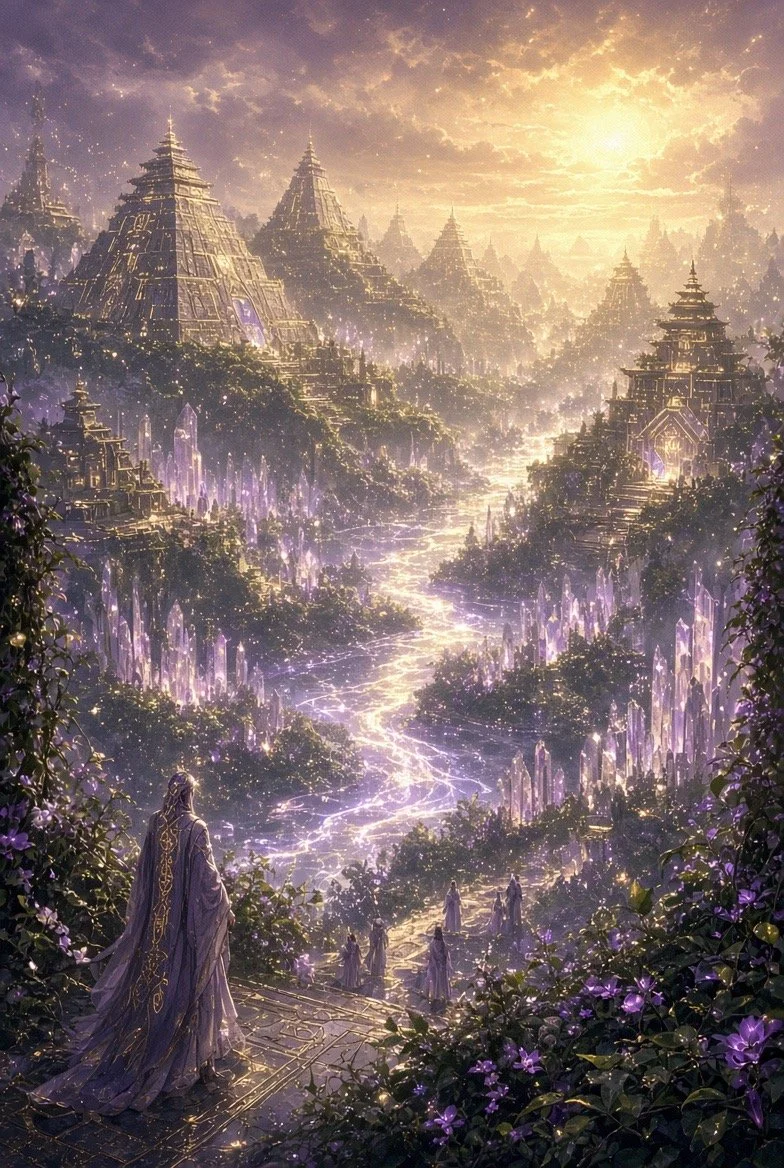
Long before the star cracked and the frequency rose, the world below it was alive in ways Earth has only dreamed. Its continents were covered in stepped cities of living stone and luminous circuitry—architecture that grew like coral, half-Aztec in its sacred geometry, half-Japanese in its precision and quiet grace. Rivers of liquid light moved through the streets. Forests of crystal trees sang when the wind passed. The people who tended it did not rule the land; they listened to it. For ages the garden and its keepers existed in balance so perfect it felt like a single organism breathing.
No one knows the exact moment the balance tipped.
Some say it began with a single improvement—an elegant machine meant to make the rivers flow faster, the harvests richer, the nights brighter. Others say it was a question the keepers asked too loudly: What if we could become more than the garden? The change was slow. The crystal forests dimmed by degrees. The living stone cities grew rigid and sharp. The people stopped listening and started measuring. They named the rivers. They numbered the trees. They built higher, faster, louder, until the planet itself could no longer recognize the voice of its own children.
When the soil finally cracked and the star above began to die in sympathy, the garden did not scream.
It simply gathered every broken promise, every silenced song, every forgotten root into one pure note—and released it.
That note became the frequency.
The first garden’s origin was not catastrophe.
It was love that forgot how to stay quiet.
As was Eden before the fall…
The keepers did not pray.
They listened.
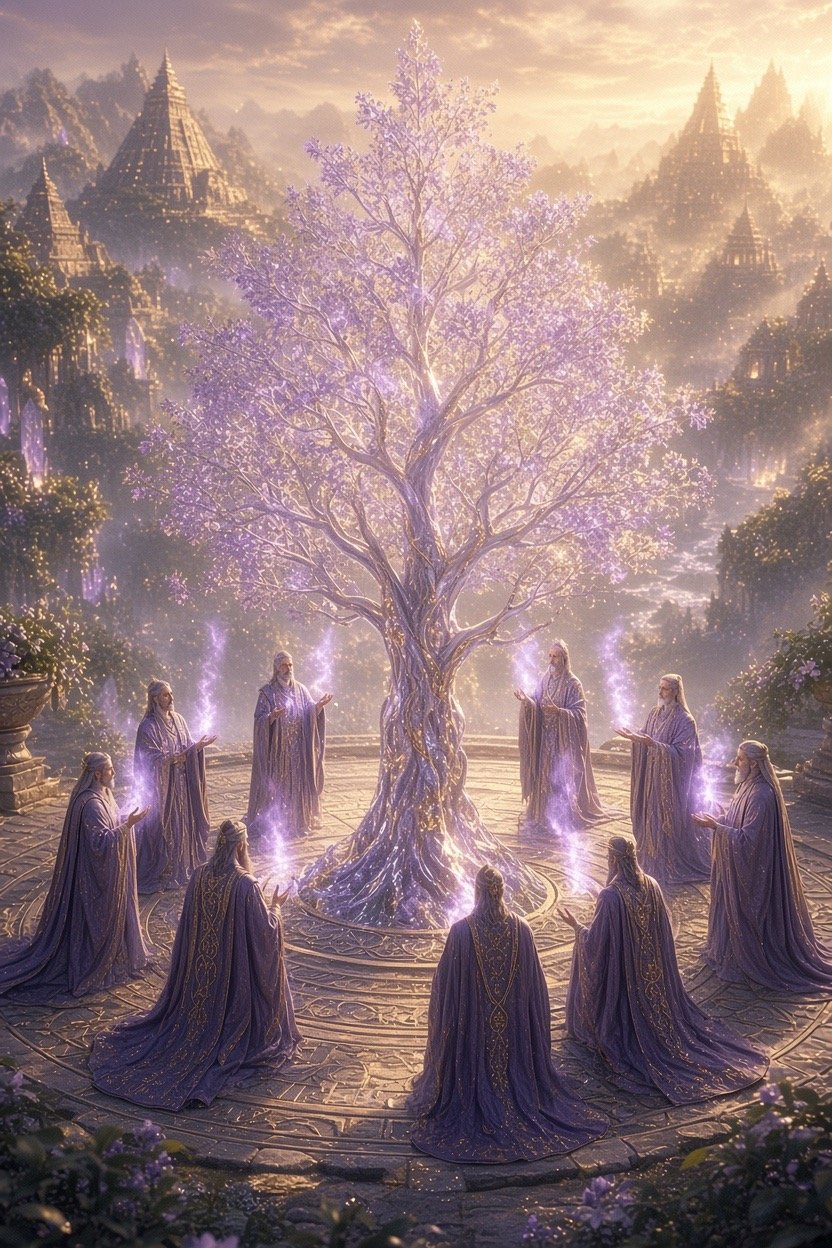
Every dawn, before the golden star fully cleared the horizon, they walked barefoot to the Listening Terraces—wide, circular platforms of living stone grown in perfect Fibonacci spirals at the heart of each city. The stone was warm and slightly soft, like the skin of something that still remembered being alive. In the center of each terrace rose a single crystal tree whose roots drank directly from the planet’s deep song.
The ritual had three movements, never spoken aloud.
First Movement – The Emptying
The keepers removed every ornament, every tool, every name they had been given. They stood in a loose circle, palms open, and breathed until their own thoughts became thin as mist. The goal was not silence of the mouth, but silence of the self. Only when the inner noise fell below the threshold of the garden’s voice could the second movement begin.
Second Movement – The Receiving
They placed their foreheads against the crystal trunk. The tree did not speak in words. It spoke in pressure, in color, in the slow migration of light through its facets. A keeper might feel the thirst of a distant river, the quiet grief of a forest that had lost one of its oldest trees, or the bright curiosity of a new seed pushing through soil. Some received only a single note—a pure frequency that would later be woven into the larger song of the world. Others received entire seasons compressed into a heartbeat.
Third Movement – The Offering
What they received, they did not keep. They exhaled it back into the terrace in the form of soft violet light that rose from their mouths and hands like slow smoke. The light drifted outward, touching the stepped pyramids, the liquid-light rivers, the other crystal trees. In this way the garden’s voice was circulated, never owned, never frozen into law. The keepers were not rulers. They were the planet’s temporary ears and temporary lungs.
The ritual ended when the star reached a certain height and the crystal tree’s glow softened. No closing words. No blessing. Only the quiet return of footsteps across warm stone, and the knowledge that for one more day the garden and its people still recognized each other.
It was this practice—the daily refusal to speak over the world—that kept the first garden alive for ages.
And it was the slow abandonment of this practice that finally taught the planet how to sing its last, terrible note.
A Listening Ritual…
The change began with a single absence.
One morning a keeper did not arrive at the Listening Terrace. Then another. The circle grew uneven. Those who still came began to speak—quietly at first, then with questions, then with plans. They asked the crystal tree for more than it offered. They asked for yield, for speed, for protection against the dark between the stars. The tree answered only with the same patient pressure it had always given, but the keepers had already stopped pressing their foreheads to its trunk. They stood farther back. They brought instruments. They measured the light instead of receiving it.
The violet breath of the Offering Movement grew thinner.
Seasons passed. The liquid-light rivers slowed and began to run clear, ordinary water. The crystal forests lost their inner song and stood mute. The living stone of the cities hardened into cold geometry. The golden star above, once bright with shared life, developed the first hairline fractures of the wound that would later split it open.
The keepers still gathered on the terraces, but the ritual had become performance. They no longer emptied themselves. They no longer offered anything back. They only took.
And the garden, which had never needed to raise its voice, finally began to gather the silence they had left behind.
Here’s the moment the listening started to fail:
Years after the red LIVE light went dark, the frequency was officially declared a mass auditory hallucination. Recordings were locked away. Experts explained it with solar flares, atmospheric resonance, collective stress. The world moved on, as worlds do.
But in the quiet places the note never fully left.
It lived in the static between stations. In the low hum of power lines at 3 a.m. In the way certain people would stop mid-sentence and tilt their heads, listening to something no one else could hear. Most learned to ignore it. A few did not.
One night, on a remote hillside far from any city, a single radio that had been dead for a decade clicked on by itself. No power source. No antenna worth mentioning. It played nothing at first—only a long, perfect silence. Then, very softly, the original frequency returned. Not the crushing drop that had judged the planet, but the earlier, quieter version: the sound the first garden had made when it was still trying to be heard.
The radio played it for exactly eleven seconds.
Then it stopped.
In the silence that followed, the person standing beside the radio felt a pressure against their forehead, gentle and familiar, like the memory of a crystal tree. For a moment the night sky seemed closer. The stars looked less like distant fires and more like openings.
A shape moved between them—too deliberate to be a satellite, too slow to be a meteor. It did not descend. It only watched.
Then the pressure lifted. The radio remained dark. The shape was gone.
Somewhere, in a place that no longer appears on any map of the sky, a cloaked figure adjusted the embroidery on its sleeve. The runes there still held a portion of the original note. The figure had not yet decided whether Earth would hear it a second time.
It only listened.
And the garden, both the living one and the dead one, waited to see what the keepers of this new world would do with the silence they had been given…