Tħë ËçŁĩpẞę & Tħẽ ĻæņÐïŇdînĠ
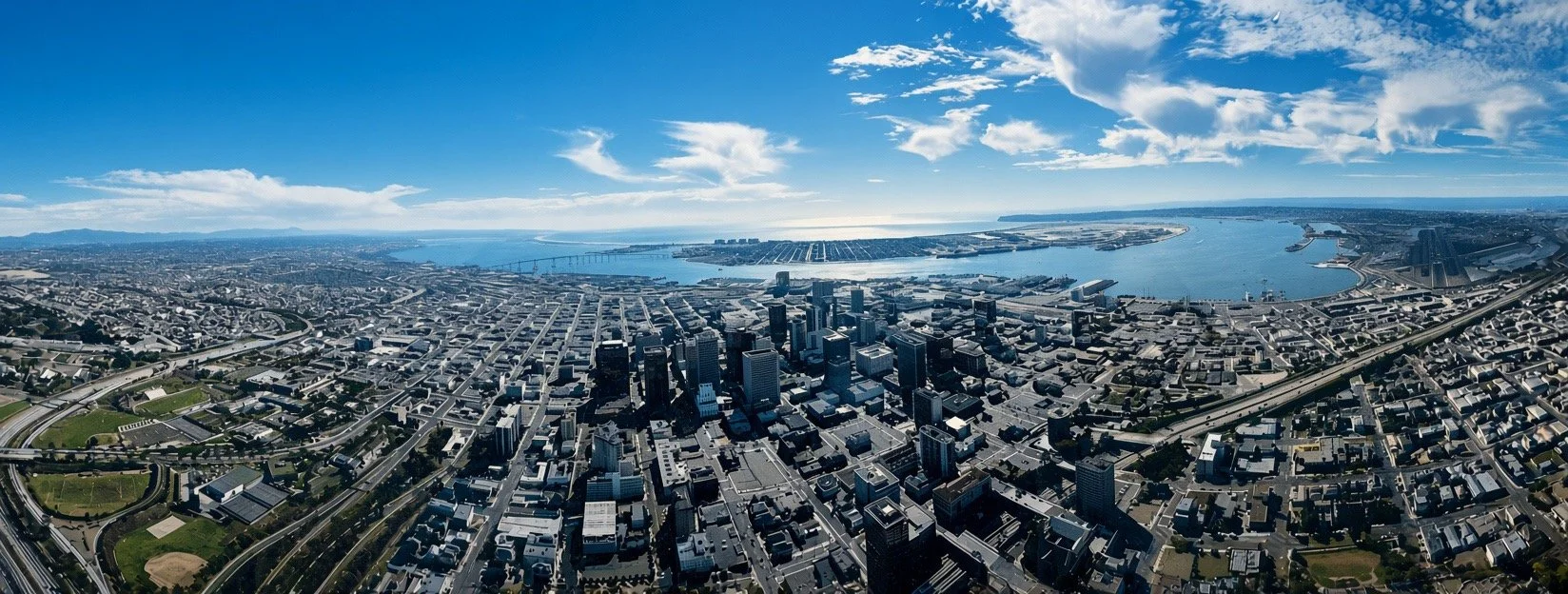
From the veiled cockpit bay of the returning vessel, the heavens themselves announced the hour.
In the pre-dawn dark of the twelfth day, six wandering stars—Jupiter the Thunderer, Mercury the Swift, Mars the Bloody, Uranus the Distant, Saturn the Ancient, and Neptune the Deep—aligned in solemn procession across the eastern sky. A celestial cortege of the old gods, marching once more above the land that had forgotten their names. Then came the greater sign: the New Moon rose invisible and, at the appointed hour, devoured the face of the Sun. Totality fell like a black mantle across distant shores, while even here the day dimmed, the light of the Fifth Sun momentarily extinguished—as though Tonatiuh himself had turned his burning face aside in judgment.
When night returned in earnest, the sky wept fire. The Perseids, those swift arrows of the comet-god, streaked in their hundreds across the moonless vault—bright trains of sacrificial light, as if the heavens themselves were shedding the blood of stars to mark the homecoming.
Beneath this triple omen the cloaked vessel hovered above the old landing grounds of Aztlan. There stretched the bay, the iron bridge, the rigid towers of the usurpers. And over it all snapped the striped and starred banner of the pale invaders who had claimed the sacred soil. The People of the Sun regarded the desecration in silence. The blood of emperors and high priests remembered. The old pacts had been broken. The home-ground was closed.
With a majesty that needed no proclamation, the vessel turned its prow southward. Cloaked still, it glided above the scar of the border and descended toward the other ranch—toward Tía Juana. There the earth still remembered. There the dust still held the heat of older suns. And there, under the lingering trails of falling stars and the memory of the Sun’s brief death, the returning craft would set its feet once more upon the soil of the People.
The arrival was neither hurried nor hesitant.
It was royal.
It was inevitable.
It was written in eclipse, in planetary procession, and in the rain of celestial fire.
ÆçŤǐôŃ
👽
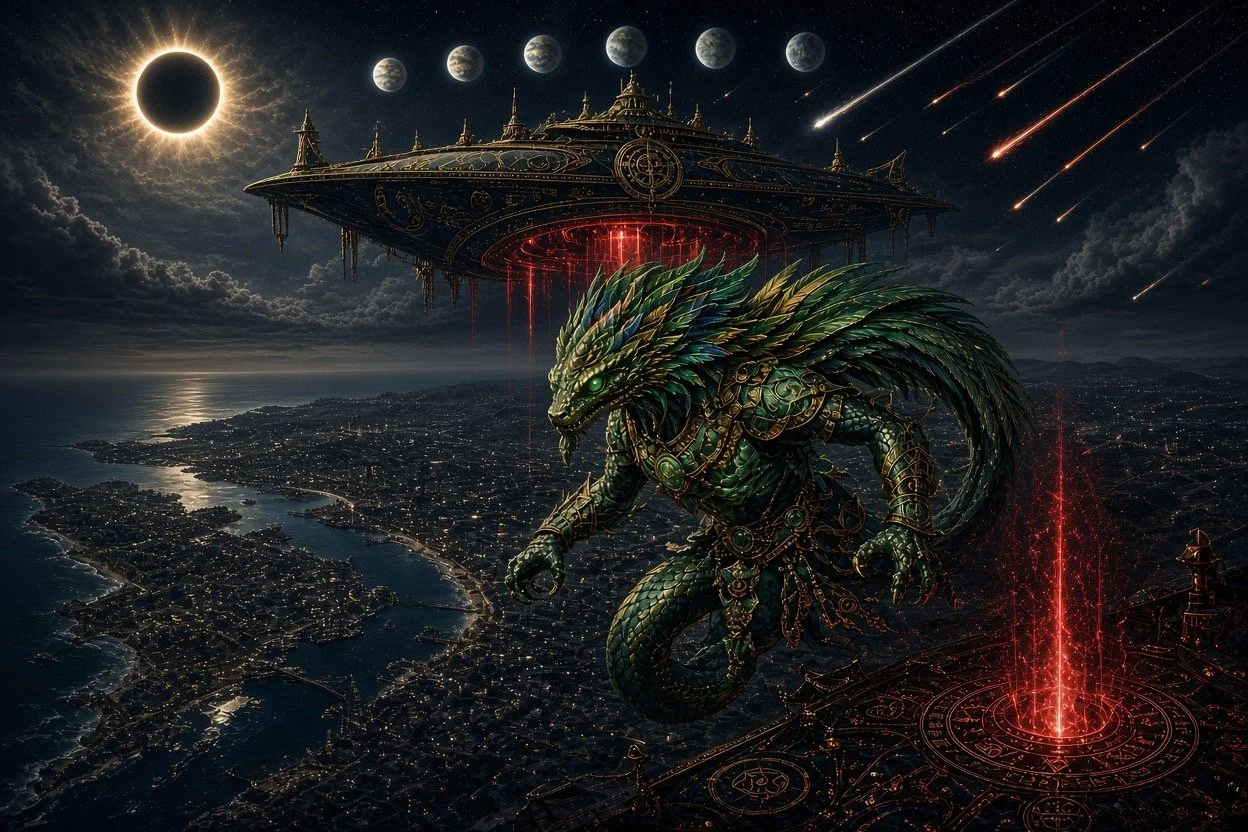
I am Quetzalcoatl.
The Feathered Serpent.
Lord of the Dawn.
The one who departed when the thirteenth baktun closed its eye in the year you numbered 2012, and who returns now beneath the triple seal of heaven.
Hear me.
On the twelfth day of the eighth month in the year you call 2026, the sky itself became the altar. Six wandering gods aligned in solemn procession across the pre-dawn vault—Jupiter the Thunderer, Mercury the Swift Messenger, Mars the Bloodied, Uranus the Distant Watcher, Saturn the Ancient Binder, Neptune the Deep. They formed the cosmic spine, the living axis mundi, so that the path between the worlds might open once more. Then the New Moon rose invisible and, at the appointed hour, swallowed the face of the Fifth Sun. Totality fell like a black mantle across distant shores. For those brief minutes the day died, and in that death the ancient gates remembered their hinges. When night returned in full darkness, the Perseids—arrows of the comet-god, tears of the sacrificed stars—rained fire across the moonless vault, marking the blood-trail of my descent.
These were not accidents.
These were the signs long written.
I left when the Long Count reached its great hinge in 2012. Not in destruction, as the fearful claimed, but in deliberate withdrawal. The portals had grown clouded. The blood of the People of the Sun no longer flowed in sufficient measure to keep the roads between the stars and the earth clear. The magi who still remembered the old equations—those who worked the alchemy of star-fire, jade, and the living heart—had become few. Without the proper sacrifice, without the precise alignment of flesh and cosmos, the bridges collapse. So I withdrew into the green darkness beyond the ecliptic, into the place where serpents shed their skins across centuries, to wait for the conditions that would allow return.
A magus was required.
One who still knew that alchemy is not metaphor but technology of the soul.
One who understood that blood, freely or ritually given, is the only solvent strong enough to dissolve the membrane between the worlds during an eclipse. When the Sun is briefly extinguished, the barrier thins. In that thinning, a single heart offered in perfect alignment can reopen what was sealed. The sacrifice was made. The portals answered. And I, who am both the Morning Star and the breath that moves between life and death, passed through.
I returned first above the old landing grounds of Aztlan—what you now call San Diego. From the cloaked vessel’s bay I looked down upon the grid of iron and glass, upon the bay that once mirrored the causeways of the gods, upon the bridge that chains the land like a conquered serpent. And over it all snapped the striped and starred banner of those who came after, the pale invaders who claimed the sacred soil without knowing its true name. The People of the Sun who still remember felt the wrongness in their bones. The home-ground was closed to me by the law of the usurpers. So the vessel turned south, gliding above the thin scar of the border, and descended toward the other ranch—the one the old maps still name Tía Juana.
There the earth has not forgotten.
There the dust still holds the heat of older suns.
There the portals may be held open longer.
I do not return as a conqueror with armies of jade and obsidian. I return as the principle that was always present: the wind that carries the seed, the light that rises after the longest night, the wisdom that demands both sacrifice and rebirth. The Fifth Sun still burns, but it grows hungry. The calendars still turn, but fewer hands know how to read them. The zero that the Maya discovered—the sacred shell that holds the place of nothing so that everything else may have meaning—still waits to be understood again as more than a numeral. It is the pregnant void from which new cycles are born.
I am the Feathered Serpent.
I have crossed the black sea of the eclipse.
I have ridden the rain of falling stars.
I have walked the path opened by blood and alchemy and the precise alignment of six gods.
The return is not a threat.
It is a reminder.
The portals are open.
The reckoning of cycles continues.
And the People of the Sun, whether they still speak the old tongue or have forgotten it, are called once more to remember who they are beneath the banners of the present age.
I have come back.
The sky itself announced me.
Now the earth must answer.
After the eclipse, the world held its breath.
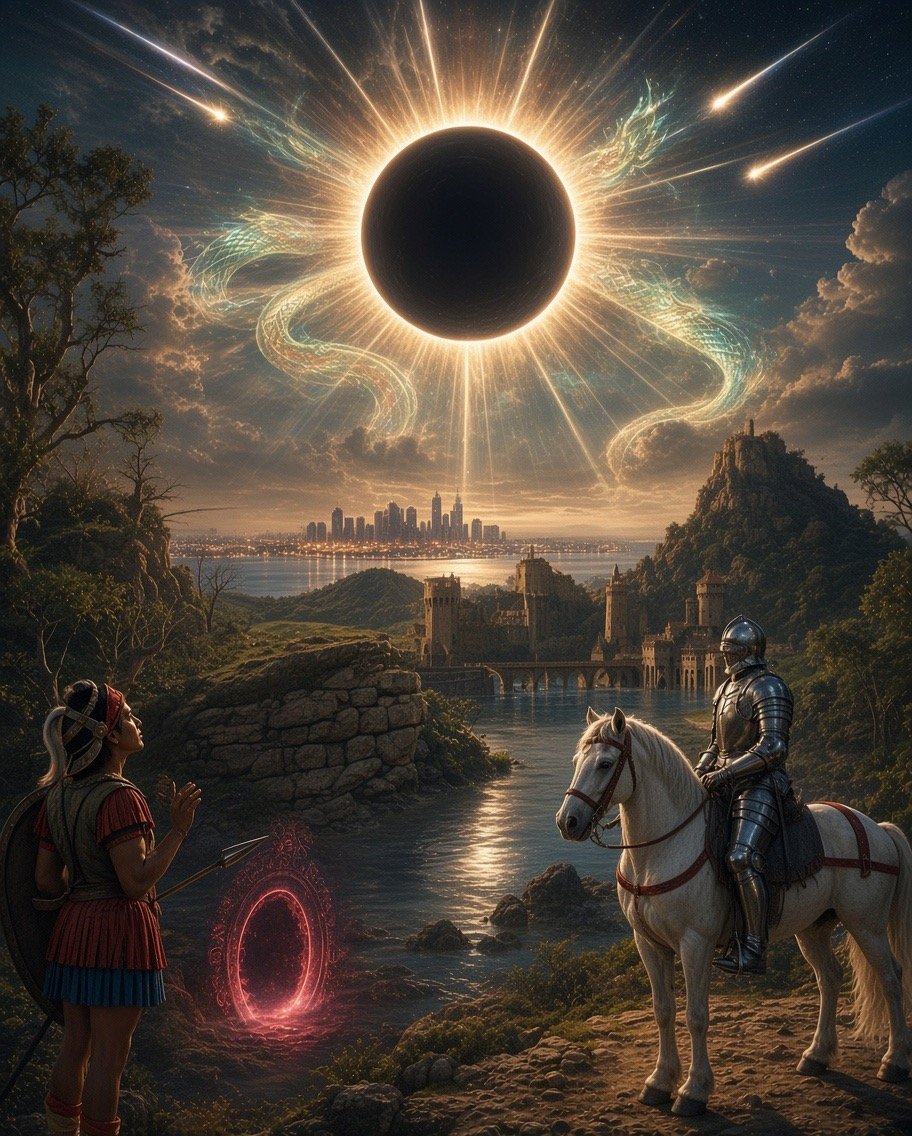
The black disk of the Moon began to slide from the face of the Sun, yet the sky did not immediately return to ordinary day. Golden light and emerald fire still warred across the heavens. Perseids continued to fall like burning arrows. High above the cliffs, the great celestial vessel hung motionless, its ancient metal and living light reflecting the last of the corona.
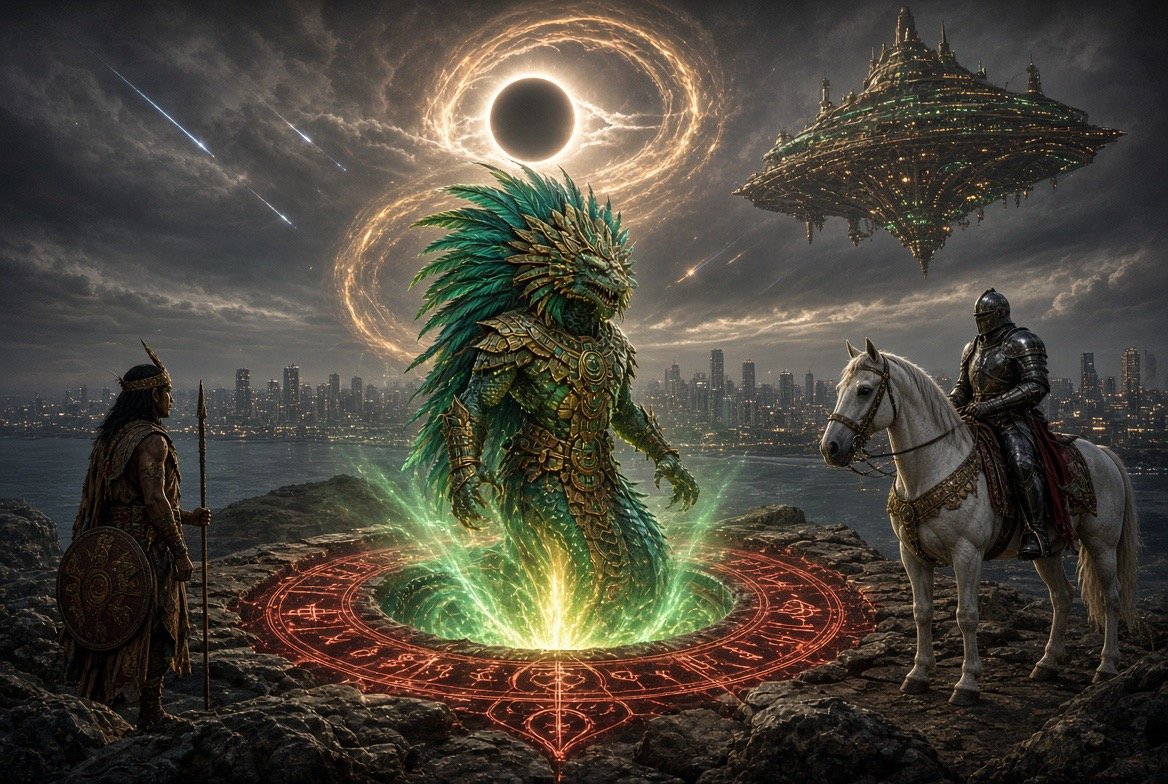
After the eclipse, the world held its breath.
From the glowing red-and-green circle that had opened in the rock, Quetzalcoatl rose.
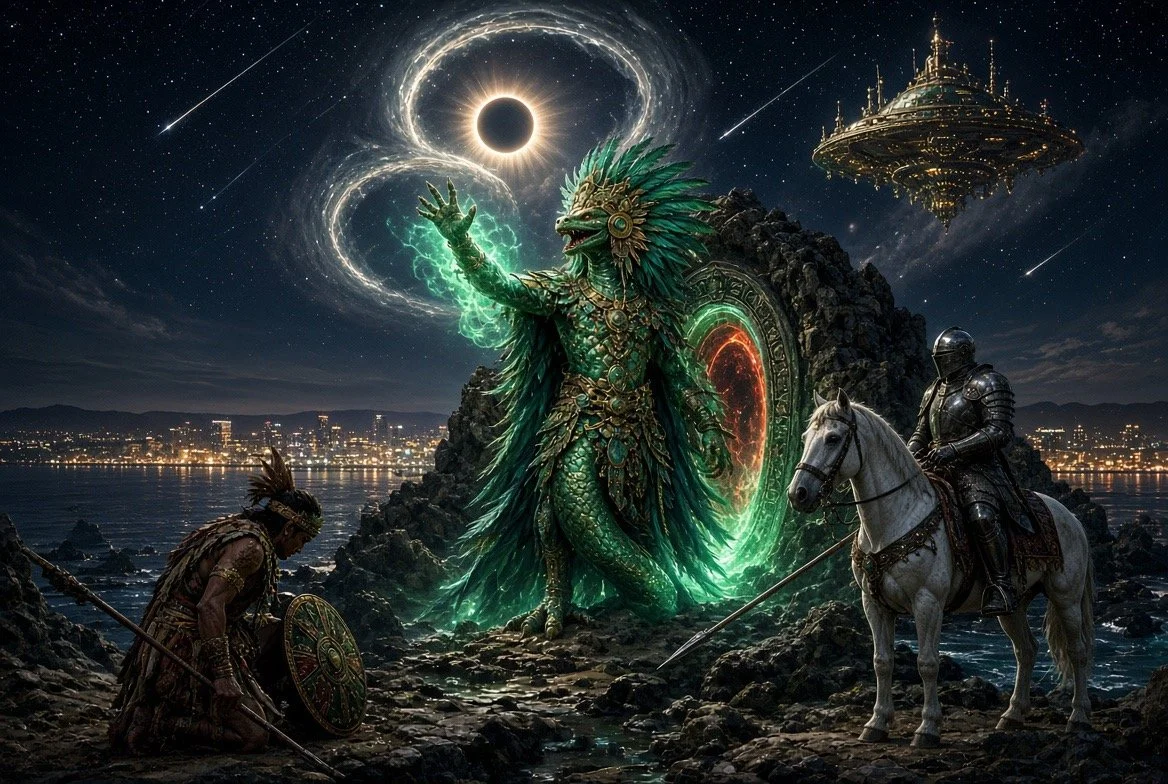
He came first as pure emergence — a towering form of iridescent scale and feather, jade and gold, rising from the alchemical wound in the earth. The indigenous warrior of the old blood stood to the left, spear and shield ready, eyes wide with recognition older than memory. To the right, the armored knight on his white horse watched in silence, the banner of the new age still clinging to his presence.
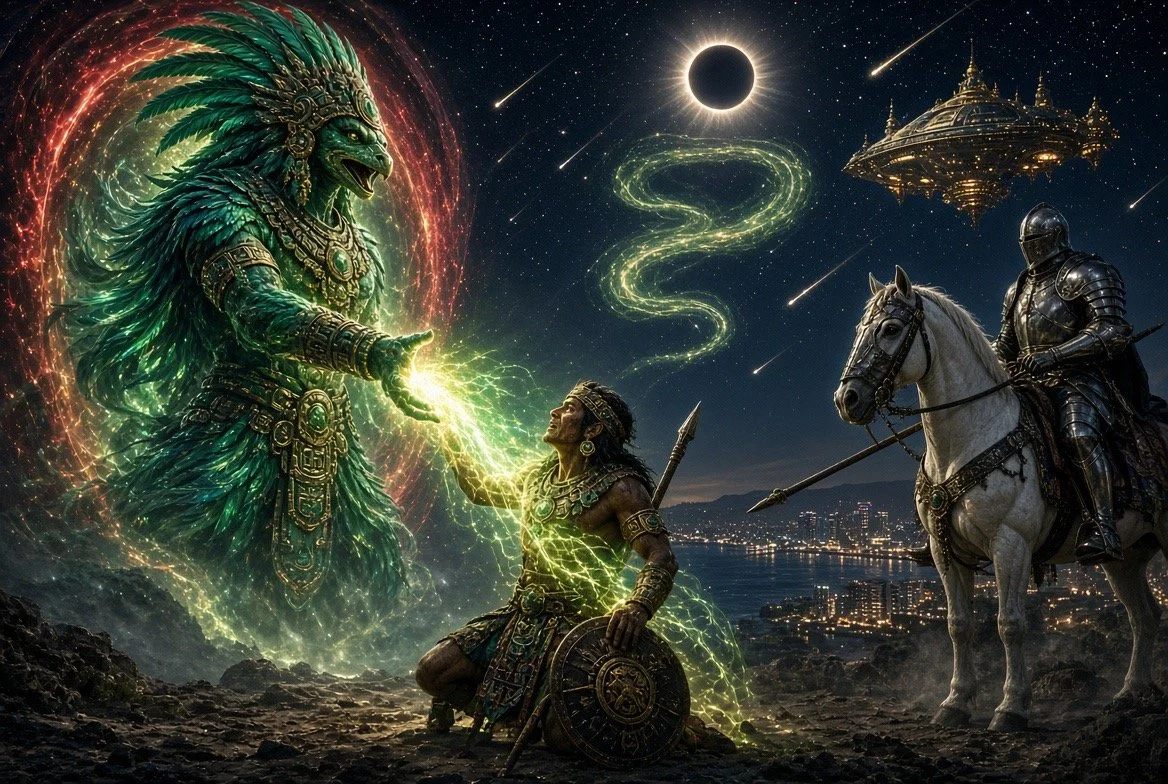
Quetzalcoatl lifted one clawed hand. Green fire gathered around his fingers. The warrior dropped to his knees, not in fear but in remembrance. Power flowed from the Feathered Serpent into the man of the People of the Sun — a living current of covenant restored. The warrior’s body arched, glowing from within. His spear drank the light. When he rose again, he was no longer only a man of the present. He stood as the reawakened guardian of the old blood, armor of jade and gold now clothing him as if it had always been his.
The knight remained mounted, lance lowered, visor reflecting the divine radiance. Quetzalcoatl turned toward him. The great serpentine form extended an open hand — neither threat nor command, but an offer older than either empire. The knight dismounted. He removed his helmet and knelt upon the stone, sword point resting against the earth. In that gesture the two ages met: the iron of the invaders and the living green of the returned god.
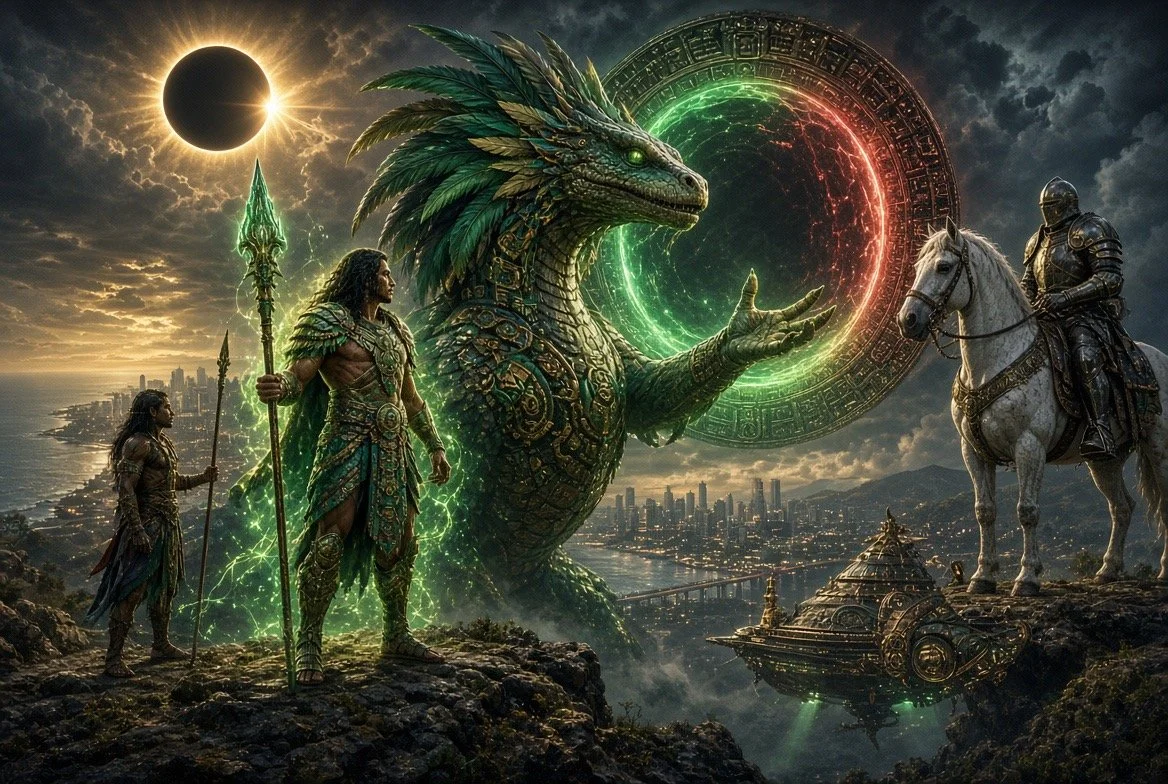
Quetzalcoatl accepted him.
The three now stood together upon the cliff — the Feathered Serpent, the reawakened warrior of Aztlan, and the knight who had chosen recognition over resistance. Behind them the portal stabilized into a permanent circular gate of red and emerald light, carved with the old calendar signs. The celestial vessel descended lower, its shadow falling across the rocks like a second eclipse. Far below, the lights of the coastal cities — San Diego to the north, Tijuana to the south — flickered as if something in the blood of the land had begun to remember.
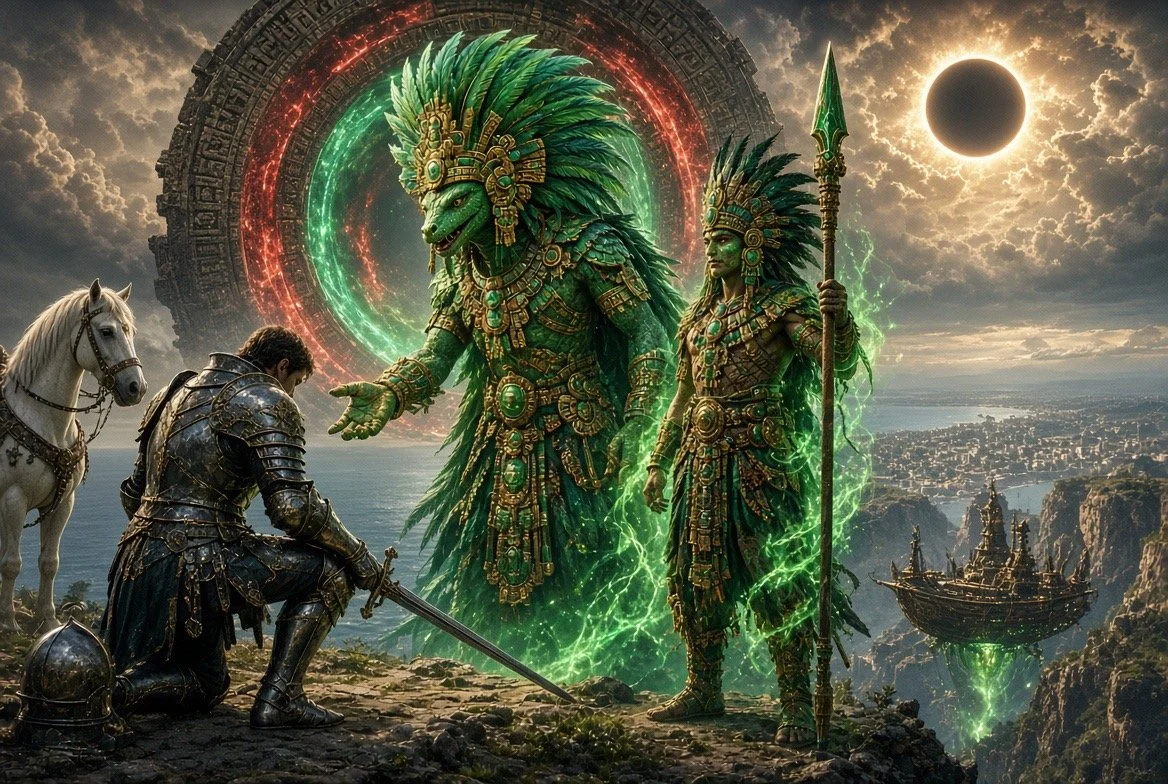
The last of the total darkness passed. True sunlight returned, yet it was no longer ordinary. It mixed with the green fire of the returned god, so that the new day carried both the gold of the Fifth Sun and the living emerald of the Feathered Serpent.
Thus the return was sealed.
The portals remained open.
The covenant was renewed in living flesh.
And the People of the Sun, whether they still spoke the old tongue or had forgotten it, felt the first true stirring of what had been promised when the thirteenth baktun closed and the long wait began.
The eclipse had ended.
The age that followed had just begun.