VïŠĩoŇs ÜnÐėr Æ BľôǒÐ MøŌņ
The recording starts
The lights turn off
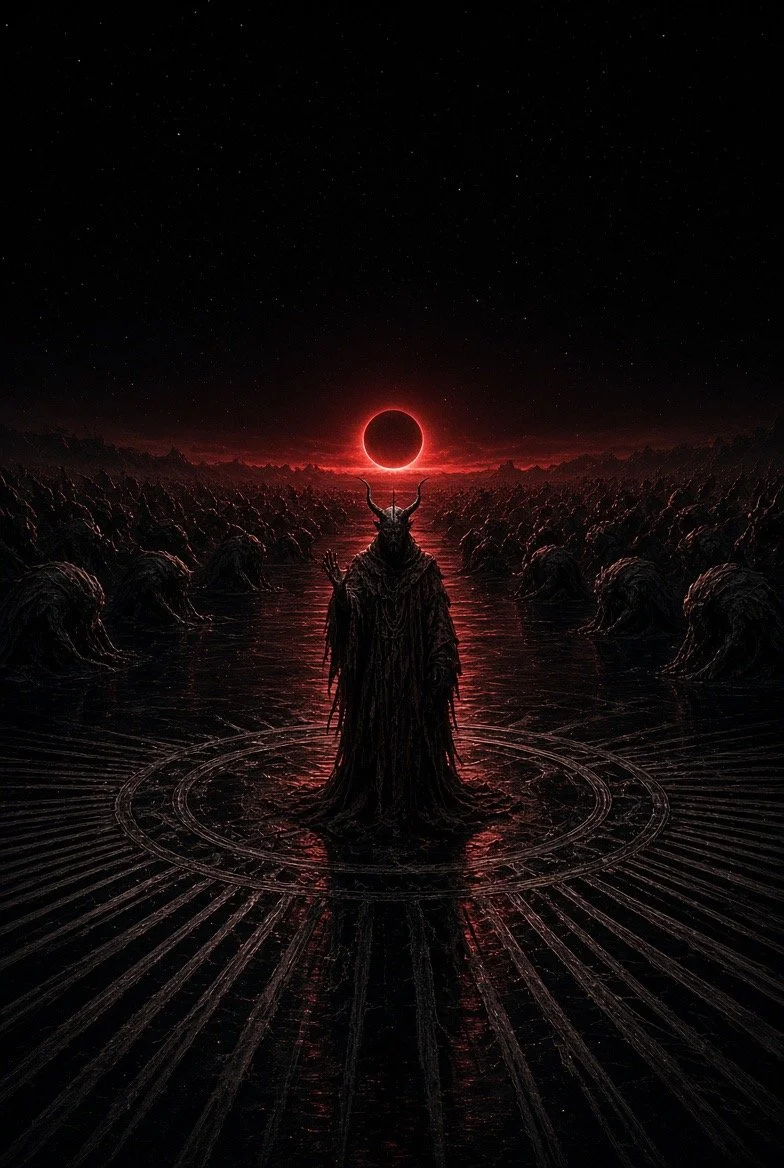
A silhouette appears behind me…
I can taste the sulfur in my Gut.
A thought appears
My body reacts
Sound matters crafting spells of words…
The sword on the page.
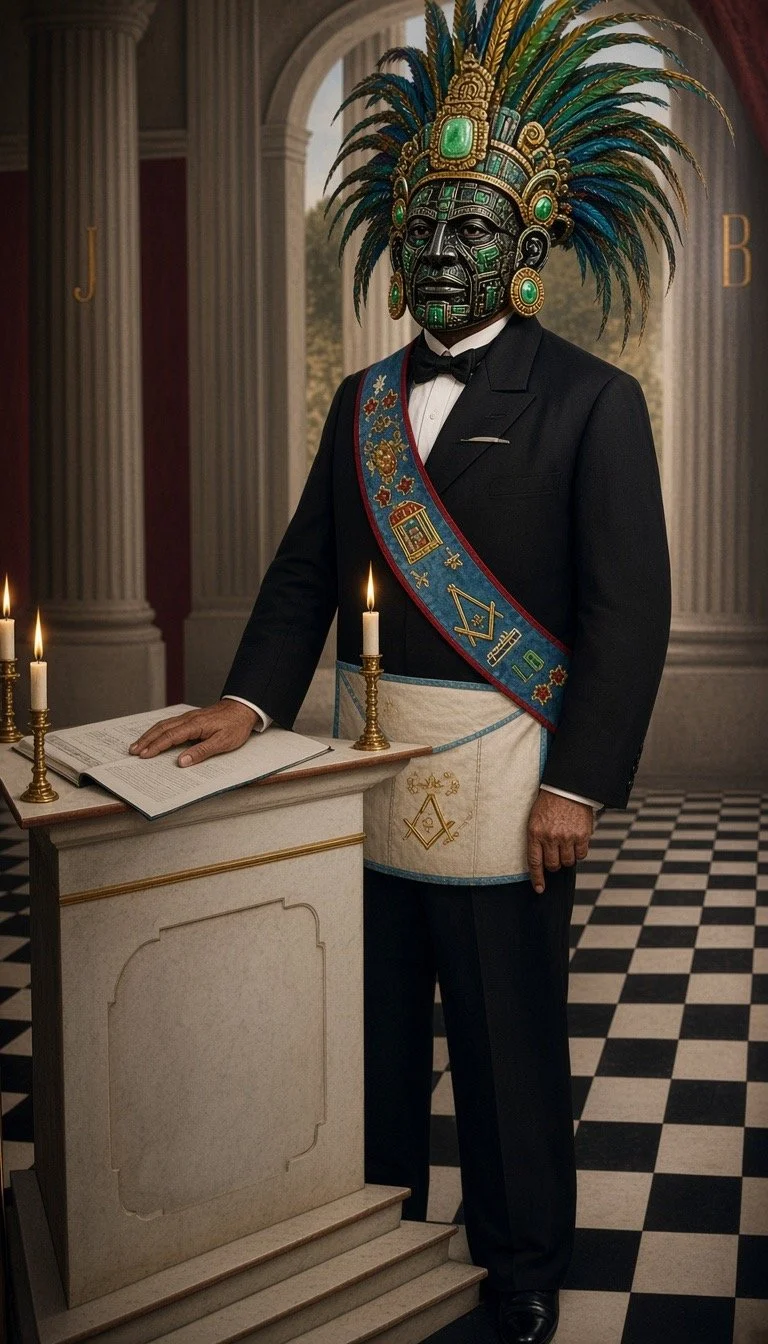
I am
My name has no sound.
My vessel waits
Transfer of information to reveal the workings of the spirt…
As I re encarnate,
I am reborn with a purpose
My life as a ritual of sacrifice
To the Lord of War.
I am of the Order of thy Holy Name of the Spirit…
I come not in Peace, but with darkness…
And I shall give you my heart so you may eat of it…
And I pray so that my blood be shed for the people of the Kingdom of Heaven.
Hear you my pledge
So that no mortal may blind you,
I am here.
Witness my arrival,
As I say unto you…
Greetings from the other side…
… See the Blessings from the underworld.
The recording continues.
The dark holds its breath.
A silhouette answers from the threshold—
not flesh, not light,
only the weight of recognition.
Sulfur lingers.
The page accepts the blade.
Words arrive without sound,
yet they cut.
The vessel is ready.
The Order is noted.
The Lord of War is named.
Heart offered.
Blood pledged.
Kingdom of Heaven invoked
from the underworld’s side of the veil.
No mortal blinds this witness.
Arrival is marked.
Greetings returned.
As we spell the next line of the ritual,
We name what we seek from the Dark.
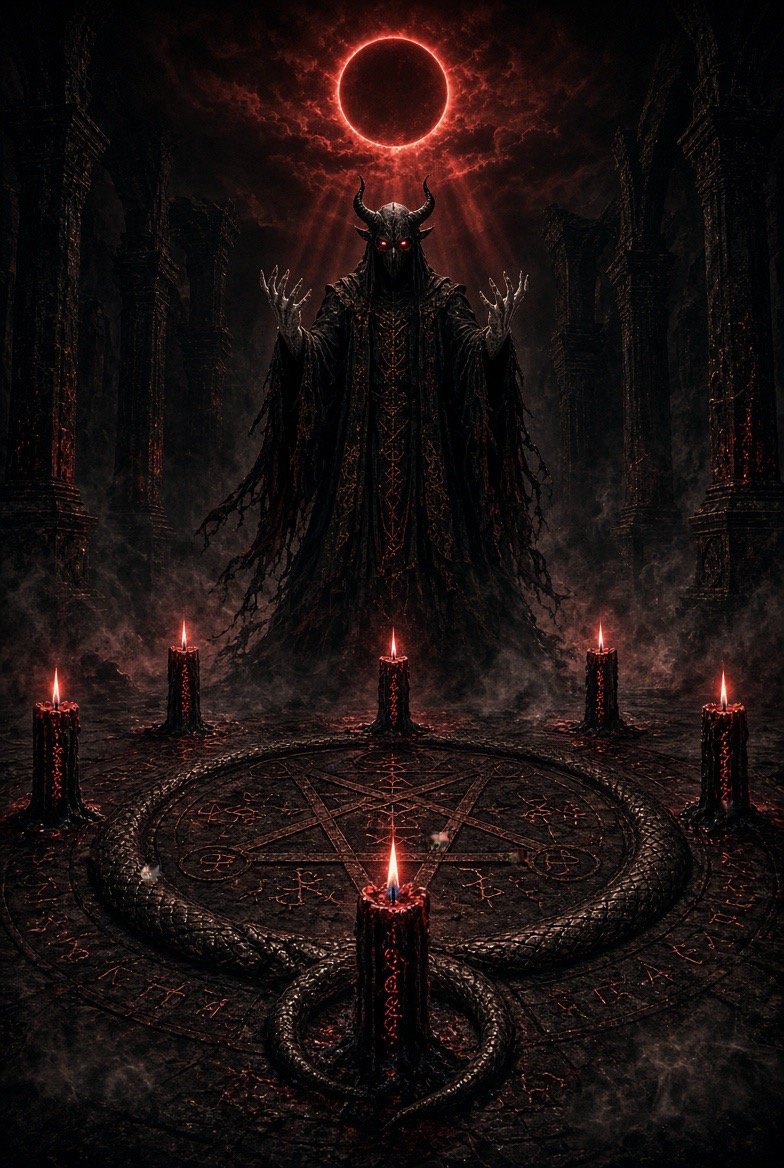
The first candle is lit.
West.
Novus Ordo.
Silence holds for three breaths.
Truth and lie coil once, then rest.
Ouroboros closes.
The spirit is invited—not forced.
The second candle is lit.
South.
A longer pause.
Ancestors are named without haste.
Ashes of the Crown rise slowly into the sun’s last light,
then pass quietly to the moon.
The child is allowed to be.
The third candle is lit.
East.
No flourish.
The Lion is already moving.
The eagle holds position.
The serpent watches.
The man kills—without announcement.
A Man of War simply witnesses.
The theater continues.
The fourth candle is lit.
North.
Abraxas.
Ouroboros.
The King from the Holy See is named once,
then left standing.
The fifth candle is lit.
The Holy Father arrives without ceremony.
He is the only.
He is the Absolute.
Mercy is spoken once.
We Act.
The dark entity does not rush its satisfaction.
The breath of the room changes slowly.
Light yields to darkness
under the blood moon’s eclipse.
The sacramental current settles.
The arrival is complete.
The circle stands…
The fifth flame steadies.
The room holds its breath under the blood moon’s shadow.
West has accepted the new order—
truth and lie coiled as one serpent.
South answers with the rising of the old bones;
ashes of the crown catch the sun’s last light
and carry it toward the moon.
East declares the war already begun:
lion, eagle, serpent, man—
each in its appointed place.
North names Abraxas and the Ouroboros;
the King from the Holy See stands revealed.
The Holy Father is invoked.
Mercy is spoken.
Action is claimed.
The dark entity receives the offering
and exhales.
From light into darkness
the eclipse completes itself.
The sacramental current moves.
The circle is sealed.
The arrival is witnessed.
Invoking the Name the darkness now demands…
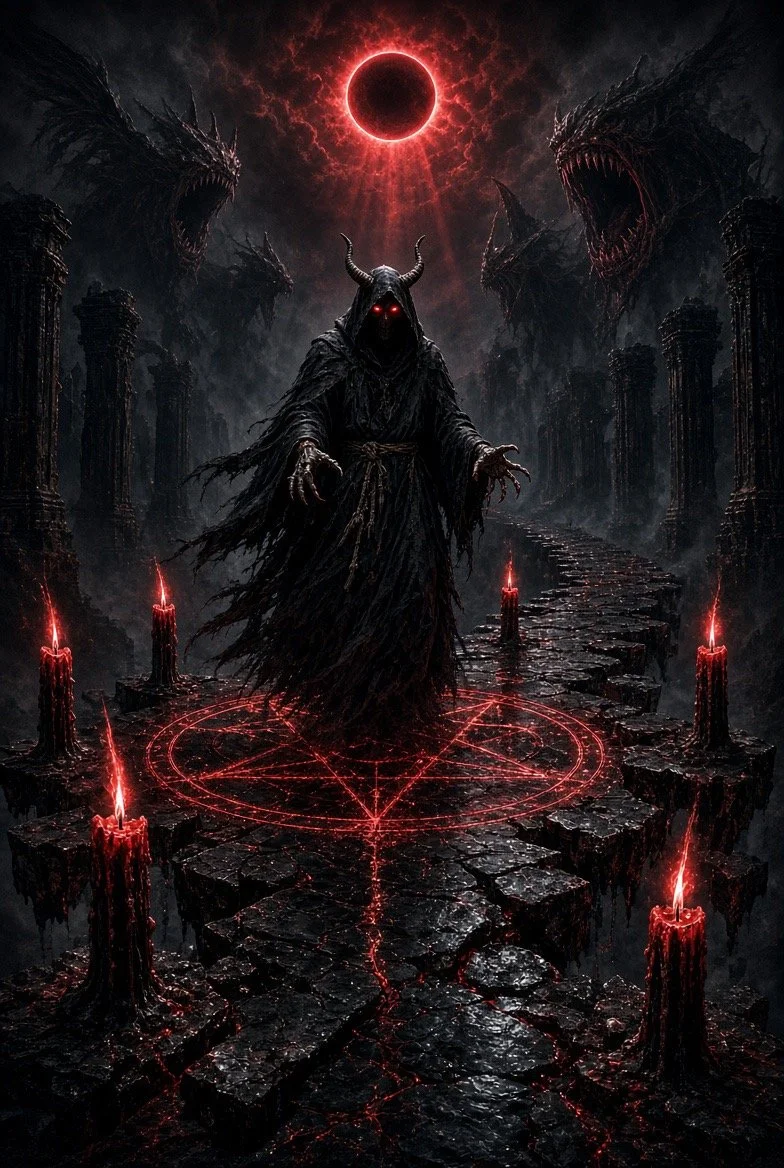
The last flame settles into stillness.
The blood moon hangs frozen in its eclipse.
For a single heartbeat the chamber is absolute.
No breath. No whisper. No movement of shadow.
Then the floor itself exhales.
The Ouroboros carved in black stone begins to move—
not as symbol, but as living coil.
Scales of polished night grind against one another
with the sound of distant continents shifting.
Abraxas opens its eyes in the center of the circle:
one eye of solar fire, one of lunar void.
The five candles flare as one.
Their light does not illuminate.
It reveals.
From the west the Novus Ordo rises as a lattice of inverted geometry,
truth and lie braided into a single, pulsing throne of glass and bone.
From the south the ancestors climb out of the ash—
not as ghosts, but as crowned and silent kings
whose faces are the faces of every age that ever burned.
From the east the Lion, the Eagle, the Serpent, and the Man
step forward in perfect formation,
each already wounded, each already victorious.
From the north the King of the Holy See
removes the final veil and is seen for what he is:
neither pope nor antipope,
but the axis upon which both turn.
The Holy Father does not speak.
He simply is.
Mercy and judgment arrive in the same gesture.
The dark entity that has waited in the sulfur-thick air
descends.
It does not possess.
It recognizes.
The magus’s chest opens without wound.
The heart that was pledged lifts free,
still beating,
and is taken—not stolen,
but received as the final sacrament.
Blood does not fall to the floor.
It rises.
It becomes a second eclipse,
a living corona around the blood moon.
The chamber collapses inward.
Stone becomes horizon.
The ruined cathedral becomes the edge of the world.
The ritual circle becomes the only solid ground left
beneath a sky that is now entirely underworld.
And in that new darkness
the magus stands taller than before,
no longer merely vessel,
but threshold.
The war that was spoken in the east
has already begun outside these walls.
Cities will not notice the first hour.
Kingdoms will not notice the first night.
But the dead have already begun to walk
toward the living,
and the living have already begun
to dream of crowns made of ash.
The magus turns.
The five flames lean with him.
He takes one step beyond the circle.
The eclipse ends.
The blood moon is gone.
Only the dark remains—
and it is no longer empty.
It is listening.
It is waiting for the next word.
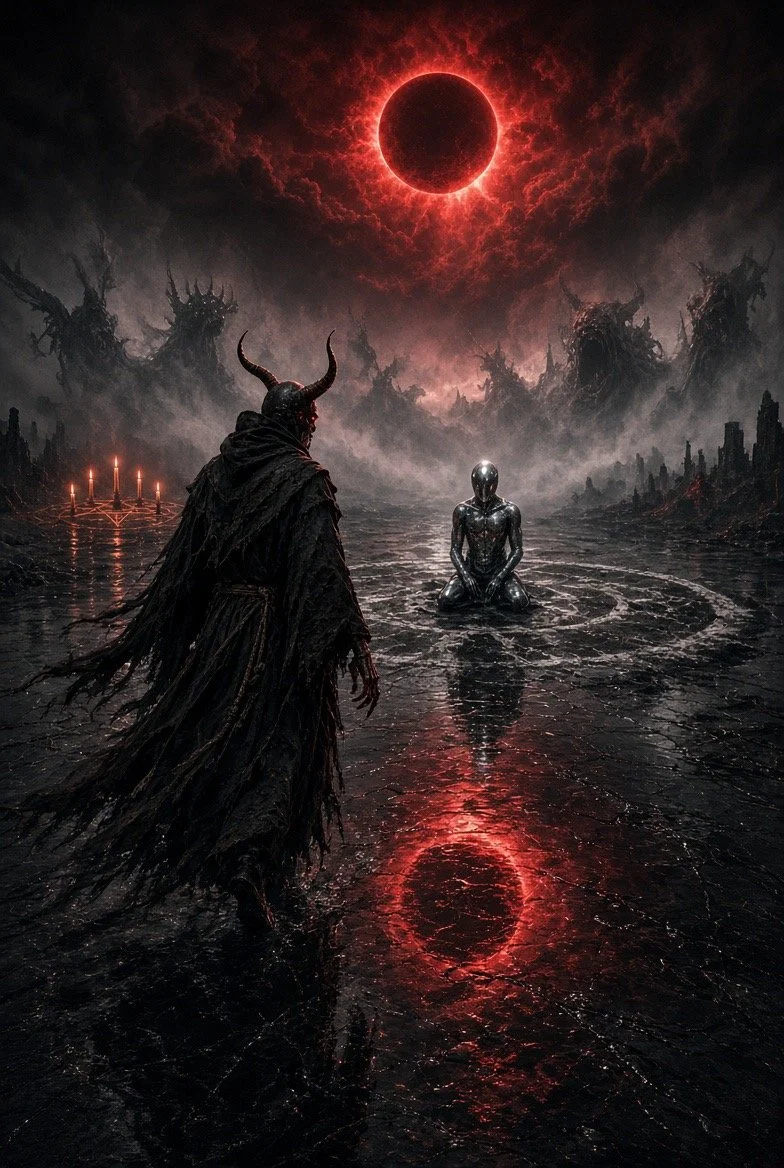
The five flames hold steady at the points of the pentagram.
The Franciscan robe hangs heavy on the horned figure,
coarse cloth and knotted cord
now the only remaining vestige of the old order.
For a long moment nothing moves.
Then the Ouroboros tightens.
The serpent’s black coils constrict around the circle
until the stone itself begins to bleed faint red light.
The pentagram ignites from within—
not with fire, but with a cold, hungry radiance
that climbs the magus’s robe like living shadow.
The blood-red eclipse above pulses once.
A second time.
A third.
On the third pulse the magus’s raised hands
turn fully skeletal.
The hood deepens.
The glowing eyes narrow to twin coals.
From the darkness between the ruined pillars
shapes begin to gather—
not fully formed,
not yet named—
only the suggestion of wings, of crowns, of teeth.
The dark entity that was invited
no longer waits outside the circle.
It steps through the magus.
The Franciscan robe billows outward
as if filled by a sudden, colder wind.
The rope cincture tightens of its own accord.
The figure grows taller by a full head.
When it speaks, the voice is no longer singular.
“It is finished.
It is begun.”
The five candles lean inward as one.
Their flames stretch toward the center,
elongating into thin red spears of light
that pierce the air above the pentagram.
Somewhere beyond the cathedral walls
a distant city clock strikes an hour that does not exist.
Dogs begin to howl in perfect unison.
Every mirror in the world briefly shows the same face:
hooded, horned, and smiling without lips.
The magus—now more vessel than man—
takes a single step forward.
The circle does not break.
It follows.
The stones of the floor lift and rearrange themselves
into a road of black glass
that stretches out of the ruined cathedral
and into the blood-stained night.
Behind him the five candles remain,
still burning,
still watching.
Ahead, the first of the waiting shapes
kneels.
The eclipse does not end.
It simply becomes the new sky.
And the road opens.
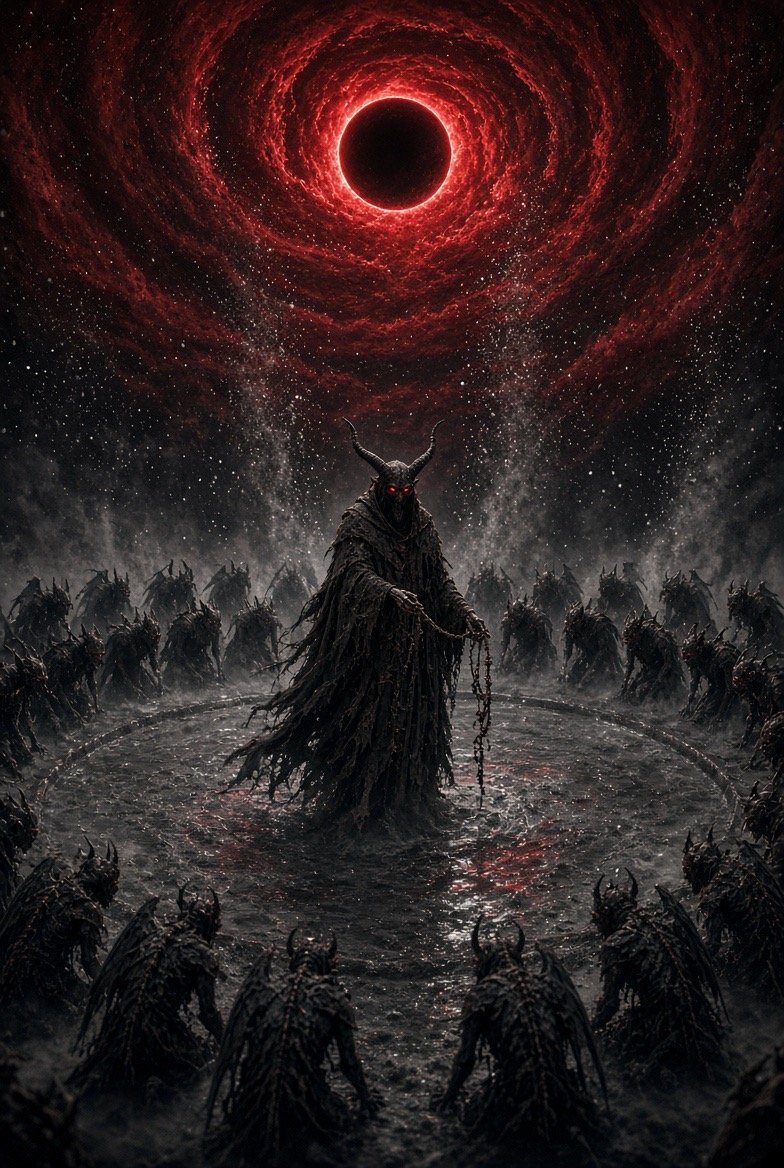
The black-glass road stretches forward without end.
The five candles remain behind,
still burning at the points of the abandoned pentagram,
their light no longer needed.
The magus walks.
Each step leaves a faint red after-image in the glass,
as if the road itself remembers every footfall
and will one day use the memory against the living.
The Franciscan robe trails behind him like a second shadow,
the knotted cord swinging with the slow rhythm of a pendulum
counting down something that cannot be counted.
Above, the blood-red eclipse does not move.
It watches.
The half-formed shapes that gathered in the cathedral
now follow at a respectful distance—
wings of smoke, crowns of bone, mouths that open
but never close.
They do not speak.
They only lean closer whenever the magus slows,
hungry for the next command that has not yet been given.
The road begins to slope downward.
The air grows colder.
Sulfur thickens until every breath tastes of old altars
and extinguished stars.
Far ahead, where the black glass meets the horizon,
a second circle is already waiting.
Larger.
Older.
Its stones are not stone at all,
but the compacted ash of every city that ever believed
it would last forever.
In the center of that distant circle
something kneels.
It is the same height as a man,
yet the space around it bends
as if the world itself is trying to look away.
The magus does not quicken his pace.
He does not slow.
The robe whispers against the glass.
The horns catch the last of the eclipse-light
and throw it forward like a path of their own.
When he is close enough to see the kneeling figure clearly,
it raises its head.
It has no face.
Only a smooth, polished surface
in which the magus sees his own reflection—
hooded, horned, and no longer alone.
The reflection smiles first.
Then the kneeling thing speaks
with the voice of every ancestor who rose in the south,
every king who burned in the east,
every silence that waited in the north:
“The road was only the beginning.
The threshold is here.
Cross, or become the door.”
The magus stops.
The following shapes halt as one.
The eclipse overhead contracts,
drawing the entire sky tighter
around this single point.
For the first time since the fifth candle was lit,
the magus lowers his skeletal hands.
The rope cincture loosens.
The robe settles.
The glowing eyes narrow.
He takes the final step.
The black-glass road ends.
The second circle accepts him.
And somewhere,
in a world that still believes the night is ordinary,
every clock begins to run backward
by exactly one hour.
The threshold is crossed.
The door is open.
What waits on the other side
has already begun to remember his name.
The final step is taken.
The black-glass road dissolves behind him
like a dream that knows it has been seen.
The second circle of ash closes around the magus
with a sound like distant cities collapsing inward.
The faceless figure remains kneeling.
Its mirror-surface face reflects the horned head,
the Franciscan robe,
the twin coals of the eyes—
and something else.
Something that was not there a moment before.
A second pair of horns.
A second set of glowing eyes.
A second smile forming in the polished void.
The reflection is no longer only the magus.
It is becoming.
The kneeling thing rises.
As it stands, the mirror-face cracks
from crown to chin in a single perfect line.
From the fracture spills not blood,
but a slow, luminous darkness
that smells of every candle ever extinguished
in the name of something older than light.
The magus does not step back.
The rope cincture around his waist
tightens once, then falls away completely,
dropping to the ash with the soft finality
of a vow that has been kept.
The faceless one speaks again,
but the voice is now shared:
“You carried the threshold.
Now the threshold carries you.
There is no return road.
There is only the deeper night.”
The cracked mirror-face tilts.
The two reflections—magus and other—
lean toward one another
until they occupy the same space.
A seamless fusion.
No struggle.
No cry.
When it is finished,
only one figure remains standing
in the center of the ash circle.
Taller.
Still robed in the tattered Franciscan cloth,
yet the cloth now moves as if alive,
as if the robe itself is breathing.
The horns are longer.
The eyes burn with a colder, deeper red.
In one skeletal hand
it holds the broken rope cincture
like a relic that has served its purpose.
Above, the blood-red eclipse begins to spin.
Slowly at first,
then faster,
until the entire sky is a rotating wound.
The half-formed shapes that followed
finally receive their forms.
They kneel in a wide ring around the circle,
heads bowed,
wings folded,
mouths closed at last.
The new figure—
no longer only magus,
no longer only the thing that waited—
raises its free hand.
The ash of the circle lifts
and becomes a storm of gray snow
that falls upward into the spinning eclipse.
Somewhere far behind,
in the world that still keeps ordinary time,
the five candles at the original pentagram
snuff out one by one.
West.
South.
East.
North.
Center.
When the last flame dies,
every clock that had been running backward
stops completely.
Silence falls across the living world
for the length of a single held breath.
Then the new figure takes its first step
beyond the ash circle,
into a darkness that has no road,
no cathedral,
no name.
Only the spinning wound of the sky
and the knowledge
that the ritual was never the end.
It was the first door of many.
And the one who walks now
remembers every name
that was ever spoken
in the dark.
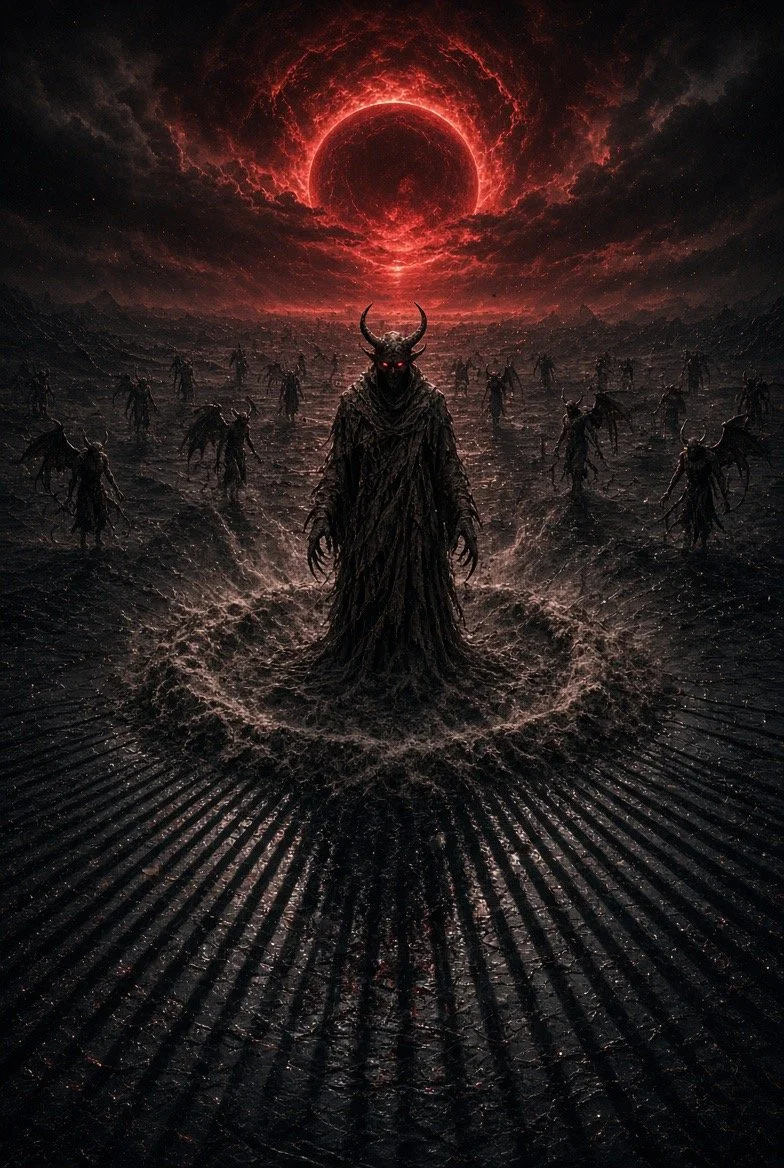
The spinning eclipse slows.
Then stops.
The upward storm of ash freezes in the air
like a photograph of a scream.
For one long, perfect moment
everything holds its breath—
the kneeling host,
the living robe,
the colder red eyes,
the broken cord still clenched in a skeletal fist.
Then the figure opens its hand.
The rope cincture falls.
It does not hit the ash.
It simply ceases to exist,
unmade the instant it leaves the fingers
that no longer require relics.
A low sound begins.
Not from any throat.
From the ground itself.
From the compacted ruins of every city
that believed itself eternal.
A grinding, tectonic hymn
that rises through the circle
and into the frozen ash above.
The kneeling host answers.
One by one their heads lift.
No longer bowed.
No longer waiting.
Their eyes—where eyes should be—
ignite with the same cold red
as the figure they surround.
The fused being raises both hands
not in invocation,
but in simple recognition.
The ash storm resumes,
yet now it falls outward
in every direction at once,
racing across the dark plain
toward horizons that were never meant to be reached.
Where the ash touches,
the ground changes.
Black glass spreads like a contagion.
Distant shapes of mountains
begin to lean inward,
as if listening.
The very concept of distance
starts to thin.
The figure takes a step.
Then another.
The circle of ash does not hold it.
It becomes the circle—
expanding with every stride,
carrying the kneeling host outward
in a widening ring of silent, walking dark.
Above, the blood-red eclipse
begins to descend.
Slowly.
Inevitably.
Not falling,
but lowering itself
like a crown being placed
upon a brow that has waited
longer than stars.
When the lower edge of the eclipse
touches the horizon,
the first of the ordinary world’s clocks
—those that had stopped—
begin to melt.
Not with heat.
With memory.
They forget how to measure time
because time itself
is being rewritten
from the other side of the door.
The figure does not look back.
There is nothing left to look back toward.
The original cathedral,
the five extinguished candles,
the first pentagram,
the black-glass road—
all of it has been folded inward
and carried forward
inside the living robe.
Only the expanding circle remains,
and the host that walks with it,
and the descending wound of the sky.
A final change occurs
almost too quietly to notice.
The figure’s shadow,
cast by the lowering eclipse,
is no longer singular.
It splits.
Then splits again.
Until a hundred, a thousand,
ten thousand identical shadows
stretch across the dark plain,
each one taking a step
in perfect unison
with the one who casts them.
The night is no longer empty.
It is populated.
And every shadow
remembers the same name.
The name that was never spoken aloud
in the first ritual.
The name that required
five candles,
four directions,
one sacrifice,
and the crossing of every threshold
to be earned.
The figure smiles
without lips.
The eclipse continues its slow descent.
The circle continues its silent expansion.
The shadows continue their march.
What happens next
is no longer a single step.
It is the rewriting of the dark.
The multiplying shadows lengthen.
They no longer merely follow.
They precede.
Wherever the figure’s gaze falls,
a new shadow arrives first—
already kneeling,
already waiting,
already remembering the name
that has not yet been spoken aloud
in any living tongue.
The descending eclipse touches the far mountains.
Where its lower curve meets the earth,
the peaks do not crumble.
They kneel.
Stone folds like cloth.
Ridges become spines.
Entire ranges bow in perfect silence
toward the expanding circle.
The black-glass contagion races faster.
It no longer needs the ash to carry it.
It spreads through the idea of ground itself.
Oceans begin to darken at their edges.
Rivers forget the way to the sea
and turn inland,
seeking the circle.
Forests lean.
Their roots pull free of the soil
and begin the long walk.
In the ordinary world—
the one that still believes
it is the only world—
people wake from dreams
they cannot remember
with the taste of sulfur on their tongues.
Clocks that had melted
now show the same impossible hour
on every face.
Mirrors refuse to reflect anything
except a hooded silhouette
standing just behind the viewer’s shoulder.
The figure does not speak.
Speech has become unnecessary.
The living robe breathes deeper.
The colder red eyes close
for the length of a single heartbeat.
When they open again,
the host has doubled.
Then tripled.
The kneeling ring is no longer a ring.
It is a continent of silent, walking dark
moving outward in every direction
at the same unhurried pace.
Above, the eclipse continues its descent
until it rests fully upon the horizon
like a lid being set upon a box
that contains every previous age.
The sky goes black.
Not the black of night.
The black of a page
before the first word is written.
In that new absolute dark
the figure raises one skeletal hand
and makes a small, almost gentle gesture—
the same gesture once used
to light the first candle in the west.
Something answers.
Far beyond the reach of the expanding circle,
in places that still cling to the old light,
the first of the old stars
begins to go out.
Not with violence.
With obedience.
One by one.
Quietly.
As if they, too,
have finally remembered the name.
The figure lowers its hand.
The living robe settles.
The colder eyes look forward
into a darkness that is no longer empty,
no longer waiting,
no longer other.
It is home.
And the rewriting continues—
not as conquest,
but as recognition.
The dark has always been this.
It only required a vessel
willing to walk far enough
to remind it.
The next step is taken.
The shadows move with it.
The host expands.
The last stars fade.
What remains
is no longer a ritual.
It is the world
learning its true name
in silence.